Monday, October 21, 2013

Thinking Outside the... BOX


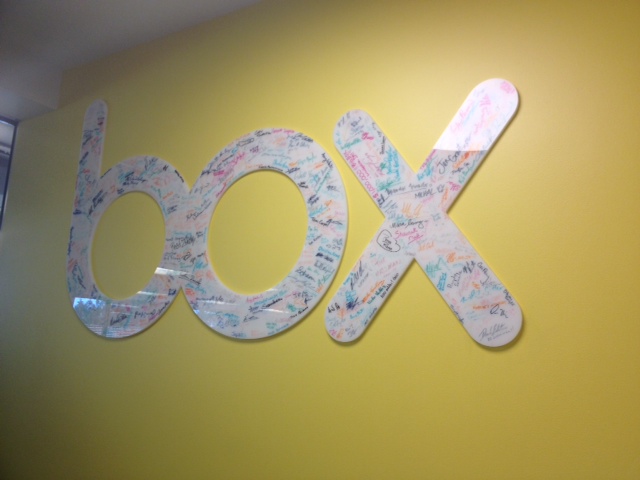
During our northern California EdJourney, our Design39Campus team was able to visit the progressive, start-up company box.

Motion. Laughing. Freedom. Trust. Collaboration. Fun. Food anytime. Mobile furniture. Writeable surfaces. Pride. Celebration.

These are are a few of the many things that became very noticeable within minutes of walking around the newly renovated 3 story building. The first piece of furniture that caught our eyes was the bright yellow slide that allowed employees to get from the second floor to the first floor. With a smile on our faces, we asked “is this only for box employees?” Thankfully, it was for everybody. Right away, we knew this was going to be an engaging experience - and we knew how our time here would end. More on this in a bit...

Employees were standing or sitting at height-adjustable tables with, what we believed, to be their choice of computer. In front of them, a small writeable surface for quick ideas and brainstorms to be jotted down. Most employees were huddled in groups, standing, talking, and working effectively with common goals of innovation and change. Writing covered the whiteboard walls and all the rooms were named with a creative twist or inside joke. Clearly, the environment inspired creativity and high quality work, while maintaining a light, joyful working experience for employees. We saw pride in their work as teams seemed to work in small, collaborative families who celebrated success in their own special ways. All workers ate lunch at around the same time in a large, open cafe where food was, of course free, and at the heart of the workforce. This space, which included ping pong tables and a stage, was big enough for all employees to fit in at once, if needed, to have all staff events.

It was nearing the end of our visit and we still had unfinished business. That’s correct. The slide.


Our team went in with the mindset that box could only offer a user a virtual cloud for digital storage.  We quickly learned that this is not the function that makes box special - it’s the fact that they allow for users to interact and collaborate with those files through a virtual network. We left thinking, how can we integrate this into our school and why would this be good for kids? More to come soon.

A few of our tweets from our experience:

@Design39Campus box employees moving constantly, having fun, and working in a collaborative environment #edjourney #d39c

Another takeaway from visits to Google and box - it's time to be creative and change the way we name classrooms #edjourney #d39c

Box has a slide!!! Our team has fun everywhere!! #edjourney pic.twitter.com/WTdgCBYVdx

Schools need to model more after innovative businesses like @ideo @google @BoxWorks #edjourney #D39C

Thanks box!

Kyle Asmus
@Design39Campus

A Call For Organic Efficiency

While participating in a session on changing school at an unconference put on by EdCampSD, a participant shared out that there are certain systems in place in schools that help to make things more efficient. . .

There are at least three ways to look at efficiency: the factory model, bureaucracy, and organic. In the factory model, efficiency is a means to an end. Specifically: cost savings. Consultants are brought in to analyze the assembly line processes and to find ways to speed up the process, or to cut the time of production, or both. Systems are developed, tested, and put into place to increase efficiency. Emphasis is on the process of getting the job done quickly, meeting the minimum requirements of the consumer, in terms of product quality, and not taking into consideration either the workers, or the possibility of improving or innovating the product. This is a very cold, inhuman way of looking at the world. In practice, monetary profit is the bottom line, if not the only line. 

In a bureaucracy, the purpose of which is to prevent change and to cement power and control, efficiency is much talked about, but rarely valued. In fact, as layers of the bureaucracy develop, and systems are put in place to manage the flow of information (read: approve or disapprove), efficiency suffers, even though there are awesome flow-charts developed to show exactly how a certain task is to be completed or pursued. The larger the institution, whether it be a car manufacturer, school district, or computer company, the less efficient the process due to the additive layering process and the defense of power, no matter how little an individual may have. Also, in a bureaucracy, it is far easier to say "no," than to convince the "higher-ups" that a new idea is worth pursuing. 

Given the changes that continue to happen in the world of work, it is becoming clear that there is another form of efficiency that is developing. A great example is the maker movement. These are individuals and small groups of people who are very agile in their thinking, and in their practice. As developments come along, new resources, both human and material, are incorporated, until the product comes to fruition. Once completed, they move on to other projects and ideas. It is an organic view of efficiency. One in which capital (money, natural resources, people) naturally flows to the area of need. Visiting Google, Box, and IDEO this week has only helped to clarify this view. Each of these companies promotes the development of ideas and the movement of personnel to pursue ideas and to solve challenges as needed. This is a flat, distributed, or organic model, which enables fluidity, reduces waste, and enables creativity.

Looking at schools and school districts, we immediately recognize the bureaucracy and, since the advent of the Standards movement, the factory model of efficiency at work. Education innovators run head-long into the bureaucracies that have grown and developed over the last century. Even well meaning and bleeding edge superintendents encounter problems with the established bureaucratic cultures entrenched in the world of education. 

In other words, efficiency, as traditionally described and encountered, inhibits innovation and creativity. For real change to occur in education, it is imperative that teachers not only band together to lead the charge, but that they also fuel the fires of the evolution of the profession, changing it from the sage-on-the-stage factory model, to the far more efficient organic model where collaboration, creativity, and innovation are the most deeply held values. 


Bret Fitzpatrick
Learning Experience Designer

Thursday, October 10, 2013

Minds in Motion @D39C


On Tuesday morning, we worked with a group of community members to begin thinking about what fitness will look like at Design39Campus.  It is always exciting to meet with people from various backgrounds and experiences.  Each person had a unique experience with sports, athletics, or movement to share with the group.

As usual, we worked through the design thinking process to think differently about "minds in motion."
Emphathy:
In this phase, we looked at fitness and thought about all the aspects of the topic.  If you have been to one of our focused workshops, you will recognize these questions.  

When you hear we are changing the way we do fitness…


  • What changes do you want to see?
  • What excites you about changing fitness in school?
  • What new opportunities do you hope your child will have?
  • What don’t you want to see at D39C?
  • What’s a deal breaker?

Individually and in partner groups, participants wrote responses on post-it notes and they were sorted by question. To see all the responses from the participants, click here.


Define the Problem:
The current model of Physical Education in schools does not meet the needs of all students.


Ideate/Brainstorm:
As usual, the most exciting part of the workshop was the group discussion and generating potential ideas to solve the problem.

Here are some of the ideas that were developed:

  • Teachers involved and participate in fitness with students. Model fitness and lifelong health to students.
  • Structured or non-structured - They need to know how to play in non-structured time, and then also how to behave in structured time.
  • Having a garden at school could also be integrated into fitness and how you fuel a body.
  • By exposing the students to many different sports, students may find a sport that they like.
  • Outside of school, participate in charity events, such as walk-a-thons, or 5Ks.  This would also give back to the community and continue to be fit.  We could also hold our own events that would promote fitness and fundraising.
  • Great Urban Race: You take your mobile devices to solve the puzzle and run to that next place!  You could do this as teams.  It would be a great team building event, too.
  • Organized games during lunch and recess.  Consider how to make this efficient so kids can organize less and play more.
  • Like the idea of kids being able to sweat, have fun, and play.
  • Focus on nutrition.  This is a natural integration to science, too.  Half of the 7th grade curriculum focuses on the body.

Do you have ideas for fitness at D39C? We would love your input in the comment section below!


Kelly Eveleth
Teacher-Athlete
@Design39Campus

Tuesday, September 24, 2013

Inquiry in Math

The Design39Campus team recently completed a math MOOC (Massive Open Online Course) titled "How to Learn Math" through Stanford University.  Professor Jo Boaler is a leading researcher and professor of mathematics education.  As a team, we are enthralled with Jo’s approach to maths and the ways it can be creativity taught.  She believes that maths should be engaging and exciting for kids and that every student can learn maths.  

Jo focuses on the importance of kids building a positive relationship with maths through inquiry.  In this video, Jo explains importance of inquiry in maths.


Kelly Eveleth
Teacher
@Design39Campus

Tuesday, September 17, 2013

I Don't Know, Yet...

As a teacher, there is nothing harder than hearing a student say, "I'm not a writer," or "I'm not good at math."  The reality is that every student can do math, or write, or read, or do anything.  The message students should be hearing is, "you can't do that... yet."  We call this the growth mindset.  

Some of our brightest students have been told over and over that they are "smart."  They believe the reason they do well is because they are innately smart.  They receive feedback such as, "You are so smart," or "You got an A without even studying... amazing!" However, when things start to get challenging, these are the students who often shut down or express the most frustration.  They avoid things that are hard because it may negatively affect their image.  They believe that their success is based on talent, versus the effort put forward.  These students have developed a fixed mindset.  

Students who have a growth mindset know that by pairing their knowledge with perseverance and the right work, they can get smarter.  They are less likely to get upset during learning experiences because they understand that these are opportunities for growth.  The feedback they hear might be something like, "Wow, you worked really hard on this project.  You know a lot about this topic. What new questions do you have?"  This sends a positive message that effort was directly related to the learning.  Students with a growth mindset might think, "I can't do this now, however, with time and effort I bet I can figure it out."


As you can see, the messages we send kids at a very early age can set them up for success or failure in their future.  Just a subtle change in the way we talk with kids can make the difference.


Hungry for more?  Check out these resources:
How Not to Talk to Your Kids, New York Magazine
The Praise a Child Should Never Hear, The Wall Street Journal


Kelly Eveleth
Teacher
@design39campus

Wednesday, September 11, 2013

What if School Were Place Where Students Could...?

We have been getting outstanding feedback in our parent workshops.  It is refreshing to see that your ideas and hopes for school align with the work that we do everyday at Design39Campus. 
At our last two workshops we changed up our format a bit and asked people to complete this sentence, What if schools were places where students could...?  Individually and then collectively as a group, parents wrote all their ideas on sticky notes.  (Keep in mind that these statements were created before we presented the ideas that the team has been working on for D39C.)

Each group summarized the ideas to create one statement to share with the group.


What if schools were places where students could...?
 
"Maximizing students' potential at their own pace."

 "Creativity and passion should be encouraged.  All kids should be accepted, feel safe, and have a mentor."
 
 "A new way of expanding positive learning."
 
"...could explore languages, music, and have many options."
 
"Creativity, explore solutions through hands-on learning and brainstorming, making one ready to face real world issues."
 
"Excited, self-motivated students who can communicate their enthusiasm and ability in real-world situations."
 
"Students were challenged, self-directed, have ownership, and able to discover their passions."
 
"Challenged, motivated in small class size."
 
"Learn at their own pace and manner."
 
"Kids could have fun learning what they want to learn at their own pace/level in an innovative environment while exploring arts and different subject matters on a different level."
 
"What is schools were a place where learning was fun and diverse, where creativity and teamwork were a priority preparing children for a global workplace.  Children could follow their passions in an open classroom."
 
"School should be a place where students are allowed a sense of freedom and security to create and explore in a self-directed environment."


How exciting is that?!  A common thread we hear over and over is the need to bring creativity back into schools.  We want students to be in the center of the learning experience.  Feedback from all of our information workshops is available on the Community Feedback section of our website.

What to know more about D39C?  Check out our guiding principles and mission statement.

What do you think?  What if school was a place where student could...?


Kelly Eveleth
Teacher
@design39campus

Monday, September 2, 2013

Design Thinking In Action @D39C


At Design39Campus we believe that students can engineer solutions to real world problems through the design thinking process.  This style of thinking encourages outside-the-box thinking and creativity in a student centered approach to learning. 


The leadership team at D39C uses design thinking everyday as we tackle the challenges of changing the way we do school.  Through our first set of informational meetings, we entered the empathy stage of the design process.  We have been asking tough questions and collecting this data from the community.  We spend hours upon hours researching and collecting ideas of things that are working in schools already, communicating with schools from around the country, and talking with experts in education.  Problems are defined and we spend time ideating and brainstorming innovative solutions.  The next step is to create a model or prototype and to test our solution, always knowing that if something isn't working, we can always take a step back in the design process.  The design process is truly at the heart of everything we do.

Still not exactly sure about this whole design thinking idea?  Let us take you through a recent problem that the D39C team encountered and show you how we used design thinking to engineer a possible solution.

EMPATHY and RESEARCH:

Because teachers at D39C will not have their own classroom space, we needed to design a way for teachers to be able to move between spaces and transport basic needs like computer, projector, and specific supplies/materials. As a team, we investigated products, looked through catalogs, used some sample products, and realized that all the products out there didn't meet our specific needs. 


With a little bit of design thinking, we should be able to solve this problem for Bret or any other teacher at D39C!


DEFINE:
The team determined that the solution would need to fit within the following constraints:
  • It needs to be mobile.
  • It needs to fit through a standard classroom door.
  • It needs to have a surface for using your computer/device.
  • It needs to have a place to house a projector.
  • It needs to have storage for teacher items (pens, post-its, etc).
  • It needs to have storage for student devices.
  • It needs to be lockable.
  • It needs to be affordable.
  • It needs to be durable.
  • It needs to have a way for devices inside to be charged (holes).


IDEATE and BRAINSTORM:

What are some possible solutions to our problem?  This is where the team sat around the table and threw out some possible ideas. 


  • We could use a wagon or some sort of device for pulling.
  • We could carry all of our supplies around.
  • We could put mobile desks in classrooms.
  • We could put stationary desks in classrooms.
  • We could buy a device that doesn't exactly meet our needs.
  • We could use a rolling podium.
  • We could design our own rolling storage cart with podium.
  • We could have stationary storage cubbies in each room.
  • We could have mobile storage cubbies in each room.
 At this point, we decided that the product we may be looking for is some sort of mobile "teacher" cart.


MODEL and PROTOTYPE:

Step 1: We discussed and decided on ideal dimensions.
Step 2: Bret drew out a detailed plan on paper of what the cart would look like.


Step 3: We needed some supplies for our prototype, so we went to our neighborhood Ralph's, Jimbo's, and Sears and they gladly donated large sheets of cardboard.


Thank you to 4S Ranch Ralphs, 4S Ranch Jimbos, and Carmel Mountain Sears for donating cardboard!


Step 4: Kyle and Bret built our prototype.


TEST and EVALUATE:


We tested and evaluated our cart to make sure our prototype met all of our requirements. We will live with the model in our temporary home at Del Norte High School and use it as we would a normal teacher cart at D39C. 


PUBLISH and PRODUCE:


We sent our specifications and pictures of our prototype to possible vendors for them to price, create, and deliver.


This teacher cart challenge is just one of many design thinking experiences the D39C team has experienced in our work so far.  It is a fluid process that guides our work as we change the way we do school.  We imagine this as a powerful tool for students as they compose a piece of writing, respond to an environmental challenge, or even design their own learning experience.  To find out more about this process, visit the "Design Thinking" section of our website

Be sure to follow our Facebook page (search "Poway Unified School District New K-8") and follow us on Twitter @design39campus.


Bret, Karen, Kelly, Kyle, Megan, Sonya, and Tom
The Design 39 Campus Team
@design39campus


Wednesday, August 21, 2013

Developing Deep Thinkers

Walking through the “E” Concourse of Houston International Airport, on my way home from an incredible week at Space Camp for Educators in Huntsville, Alabama, an experience that I will highly recommend for any educator, regardless of age or curriculum preference, I found myself returning to a vendor cart and purchasing a logo t-shirt that I just had to have.

On the front of the shirt there is a very cool NASA logo on the upper left chest to remind the viewer that yes, we, the USA, have put humans out in space, even landed on the moon, and we are serious about maintaining our presence in this endless frontier. Filling the rest of the front of the t-shirt, in large, bold letters, is a famous quote from the movie about the Apollo 13 mission, the one where there was a bit of a problem that arose with the oxygen supply, and the folks back in Houston, most of whom were young engineers, were asked to solve the problem of mating a round filter with a square hole or, the astronauts die. According to Jerry C. Bostick, Flight Dynamics Officer for the Apollo 13 mission, describing the scene in Mission Control to the screenwriters for the movie after being asked if some people had panicked, Mr. Bostick explained that, "No, when bad things happened, we just calmly laid out all the options, and failure was not one of them. We never panicked, and we never gave up on finding a solution." Of course, the scenario entailed coming up with a way to solve the filter problem, in a space capsule miles above Earth’s surface, using only the materials that were available in that same capsule, and if a solution was not found, people died. Period.
Carrying my brand new, black as deep space, “Failure is not an option!” t-shirt gave me a great sense of hope and purpose as I continued on to the gate where my plane would carry me back home to sunny Southern California. And yet, there was an awkward sense of uneasiness that came over me while thinking about the statement as I tried to reconcile it with the many different ideas the team I am working with and I have been working on as guiding principles for the new K-8 school we are developing. If we are tasked with producing young adults who are capable of solving real-world problems, in a collaborative environment, working within real constraints, using the resources available, by a deadline, how in the world can we accomplish this if everyone’s attitude toward learning is that “failure is not an option?” Could it be that our culture has adopted this quote without really thinking it through? After all, if failure really was such a horrible thing, why in the world would we, as parents, EVER let our children even attempt to walk? They WILL fall down! Often! Even get hurt. Bump their heads. FAIL! The horror!
Clearly, failure isn’t that bad. In fact, if we were to take another look at the above learning to walk scenario through a different lens we may begin to see what real learning actually looks like. It’s human nature. We long to try things, to experience things, to reach farther, run faster, swim, even fly, all of which involve failures along the way. And it is through these failures that we actually do our better learning. It is through failure that we learn, if we’re paying attention, what NOT to do the next time. Guiding us towards success if we have the mindset to persevere. In other words, if all we do is go through school being shown what will be on the test, and then regurgitating said material onto the test, earning an “A” for quality regurgitation, we have not learned anything more than what a computer can do. Put that same person in Mission Control under the Apollo 13 circumstances and, well, without the solution already in mind because someone had given it to them. . .
While none of us would disagree that failure to solve the Apollo 13 problem was not a viable option, since it would have involved the deaths of fellow human beings, when it comes to educating our children, it seems that we need to remember the lessons of our own early years. We all had to learn to crawl, to walk, to chew, to clap, to run, to ride a bike, and every one of these steps in our lives involved multiple failures. Some even hurt. All of these learnings take place inside your brain, building the neural pathways that will enable you to repetitively perform seemingly impossible tasks like accurately kicking a soccer ball, or completing a 2-½ front flip off the 3 meter board, or playing a favorite song on your guitar, over and over again. Failure is the basis of all of our learning. So, when I go back to school, I’m going to wear my new shirt with pride because I now understand that “Failure is not an option,” it is imperative.

Bret Fitzpatrick
Teacher
#Design39Campus

Saturday, August 10, 2013

Welcome to the Design 39 Campus Blog!


We are so glad you are here!  This is a great opportunity for us to share what we have been working on.  You can expect frequent updates from our team on our latest research and planning, as well as updates on school construction.

Speaking of construction, have you seen the school site lately?  Perhaps you have seen the gigantic crane looming overhead while driving down Camino Del Norte?  Steel beams are quickly multiplying and we now have our first set of structures framed.  This is the view from the south side taken from the Del Norte High School parking lot.  The outdoor pavilion, fitness center, and cafeteria are now in place!  


The Design 39 Campus team will be working out of Del Norte High School this year while our school is being built.  Of course, one of the advantages of this set-up is that we get to be across the street from our soon-to-be home.  We have our own collaboration classroom, which we have fondly nicknamed the "collaboratory."  The past few weeks have been spent designing our space and plastering the walls with sticky notes and idea maps.  Our focus this month has been determining our critical path and creating a timeline of our upcoming work.

We hope you are as excited about Design 39 Campus as we are!  Be sure to follow us on Facebook (Poway Unified School District New K-8) and Twitter (@Design39Campus) for more updates!
 
 
Kelly Eveleth
Teacher
@Design39Campus